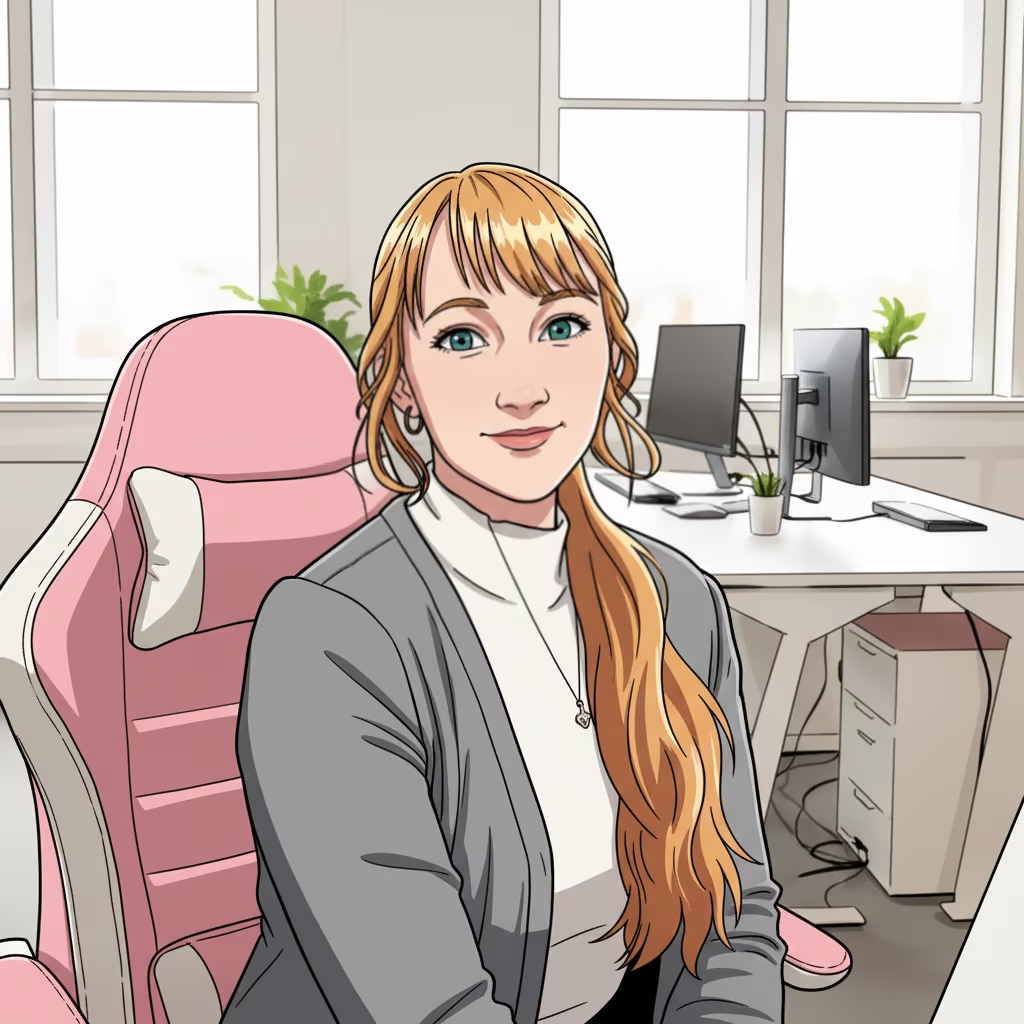
If you had asked me years ago what I would be doing today, I would not have said web development.
I have a Master's degree in Psychology. I spent years working in clinical settings, psychoeducation, and team leadership. My professional world revolved around helping people understand themselves and heal.
And yet today I build websites and digital tools.
Not for startups or tech companies, but for therapists.
This path may seem unusual from the outside, but for me it is a continuation of the same mission: helping people get the support they need.
Why I Left Institutional Psychology
During my years working in institutional healthcare, I began to notice a pattern.
Many of the systems meant to support patients were quietly working against the very process of healing.
Appointments were short.
Administrative work was overwhelming.
Professionals were exhausted.
Patients often had to navigate layers of bureaucracy before they could even reach someone who could help.

The deeper the psychological work needed to go, the less the system seemed designed to support it.
At the same time, I saw something else: many people were actively searching for long‑term therapy in private practice.
They wanted continuity, trust, and space to work through complex issues.
But finding the right therapist was often surprisingly difficult.
The Hidden Barrier: Therapist Websites
While trying to help patients find private therapists, I started visiting many therapy websites.
And what I saw surprised me.
Some sites looked like they had not been updated in decades.
Others were confusing, cluttered, or missing basic information.
Contact forms were missing.
Scheduling options were unclear.
Some websites felt cold or impersonal.

For someone already feeling vulnerable and unsure about reaching out, these small barriers can be enough to stop the process entirely.
That moment of asking for help is fragile.
That moment exists online too.
And a website can either support it or unintentionally undermine it.
Many therapists start with website builders because they seem easy. But I've seen how the hidden costs - of privacy, control, and client trust - can outweigh the convenience.
Learning to Build Websites
So I began learning how websites actually work.
I started with the fundamentals: HTML and CSS.
Then JavaScript.
Eventually backend technologies like PHP and Python.
The deeper I went, the more I realized something interesting.
Programming and psychology share a surprising amount in common.
Both involve careful observation.
Both involve understanding complex systems.
Both require patience and attention to detail.
And both involve solving problems that are not always obvious on the surface.
What began as curiosity gradually turned into a new professional path.
Why Therapist Websites Are Different
Building websites for therapists is not the same as building websites for most other professions.
A therapy website is not simply a marketing tool.
It is often the first emotional contact between a therapist and a potential client.
Someone visiting that website may be anxious, unsure, or struggling.
They may have spent days or weeks gathering the courage to look for help.
The design of that digital space matters more than most developers realize.
It needs to feel calm, clear, and safe.
It needs to communicate trust.
It needs to respect privacy.
And it needs to make it easy for someone to take the next step.
Many web developers are excellent at performance optimization or visual design, but they rarely understand the emotional context of therapy.
That context changes how a website should be built.
Bridging Two Worlds
Today my work sits at the intersection of two fields that rarely speak the same language: psychology and web development.

Therapists understand people.
Developers understand technology.
But therapist websites require both perspectives at once.
Because of my background in psychology, I approach websites differently.
I think about how a visitor might feel when they arrive.
I think about the emotional state someone may be in when they decide whether to send that first message.
I think about privacy, accessibility, and the subtle signals that create trust.
My goal is to create digital spaces that reflect the same care therapists bring to their physical offices.
What This Career Change Taught Me
Looking back, leaving psychology was not really leaving the work of helping people.
It was changing the way I contribute.
I learned that our previous experiences do not disappear when we change paths.
They shape how we approach new challenges.
I learned that frustration with broken systems can sometimes become the starting point for building something better.
And I learned that sustainable work matters.
Helping others is important, but it has to be done in a way that allows professionals to remain healthy and present in their own lives as well.
Supporting Therapists in the Digital Space
Today I build custom websites for therapists and counselors who want their online presence to reflect the values of their practice.
Calm.
Clear.
Respectful of privacy.
And intentionally designed for the people they serve.
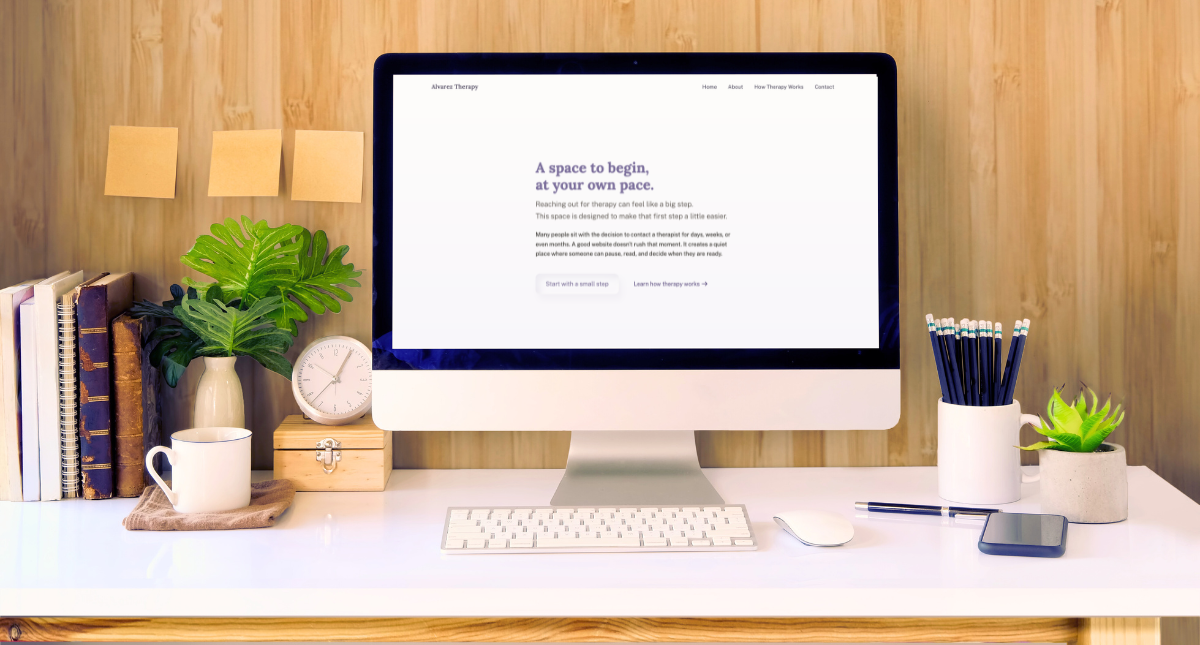
If you are a therapist and your website currently feels more like a technical obligation than a natural extension of your work, you are not alone.
Many therapists feel that tension.
The goal of a therapist website is not to impress search engines or follow design trends.
It is to create a space where someone who needs help feels safe enough to take the next step.
Final Thoughts
Careers do not always follow the paths we originally imagine.
Sometimes the skills we develop in one field end up solving problems in another.
For me, psychology and web development turned out to be more connected than I ever expected.
Both are ultimately about understanding people and creating environments where meaningful change can happen.
And sometimes that environment begins with a website.
If you're a therapist and your website doesn't feel like a natural extension of your work, I understand that tension. You didn't become a therapist to struggle with technology.
I offer a free call for therapists who want to explore whether a different kind of website might serve them and their clients better. No pitch, no pressure - just a conversation about what you're working with and what might help.