Your practice.
Your data.
Your website.
Actually yours.

I build custom digital spaces for therapists - hand-coded, privately hosted, and built by someone who understands both the code and the work it's meant to support.

You've probably looked at your website recently and felt something between mild frustration and quiet resignation.

Maybe it loads slowly. Maybe the SSL certificate expired and the browser is now warning your potential clients away. Maybe it looks like it was built in 2014 - because it was. Maybe it doesn't exist at all, and you're still relying on a Psychology Today listing and word of mouth.

Or maybe it looks fine on the surface, but you know the booking link goes to someone else's platform. Your client data lives on servers you've never seen, under terms you didn't fully read. And somewhere in the back of your mind, you wonder whether any of this is actually GDPR-compliant - or whether you're just hoping it is.

You didn't become a therapist to manage a patchwork of third-party tools and outdated infrastructure.
And you shouldn't have to.

Not a platform. Not a template.
A developer who gets it.

Most web developers understand code. They don't understand what it means to hold someone's most vulnerable data. They don't think about what a potential client feels at 11pm when they finally work up the courage to search for help. They don't know why "just use Squarespace" is not a neutral suggestion for a therapy practice.
I do. And I build accordingly.

Bespoke, not templated

Every site I build is written from scratch. No drag-and-drop builder. No platform you're renting. No "this feature costs extra next year." The code is yours - permanently, legally, completely. Take it to another developer tomorrow if you choose. I won't be offended.

Privacy as architecture, not afterthought

GDPR compliance isn't a checkbox I tick at the end. It's a constraint I build around from the start - optional, privacy-conscious analytics, validated forms, no third-party data harvesting, SSL that doesn't expire without warning, proper imprint and privacy policy. Your clients trust you with their most vulnerable moments. That trust extends to their digital footprint.

The foundation for everything else

A hand-coded, privately hosted website isn't just a website. It's the infrastructure that makes private scheduling, secure client communication, and custom tooling possible - without depending on platforms that can change their terms, raise their prices, or simply disappear.

See the philosophy in action

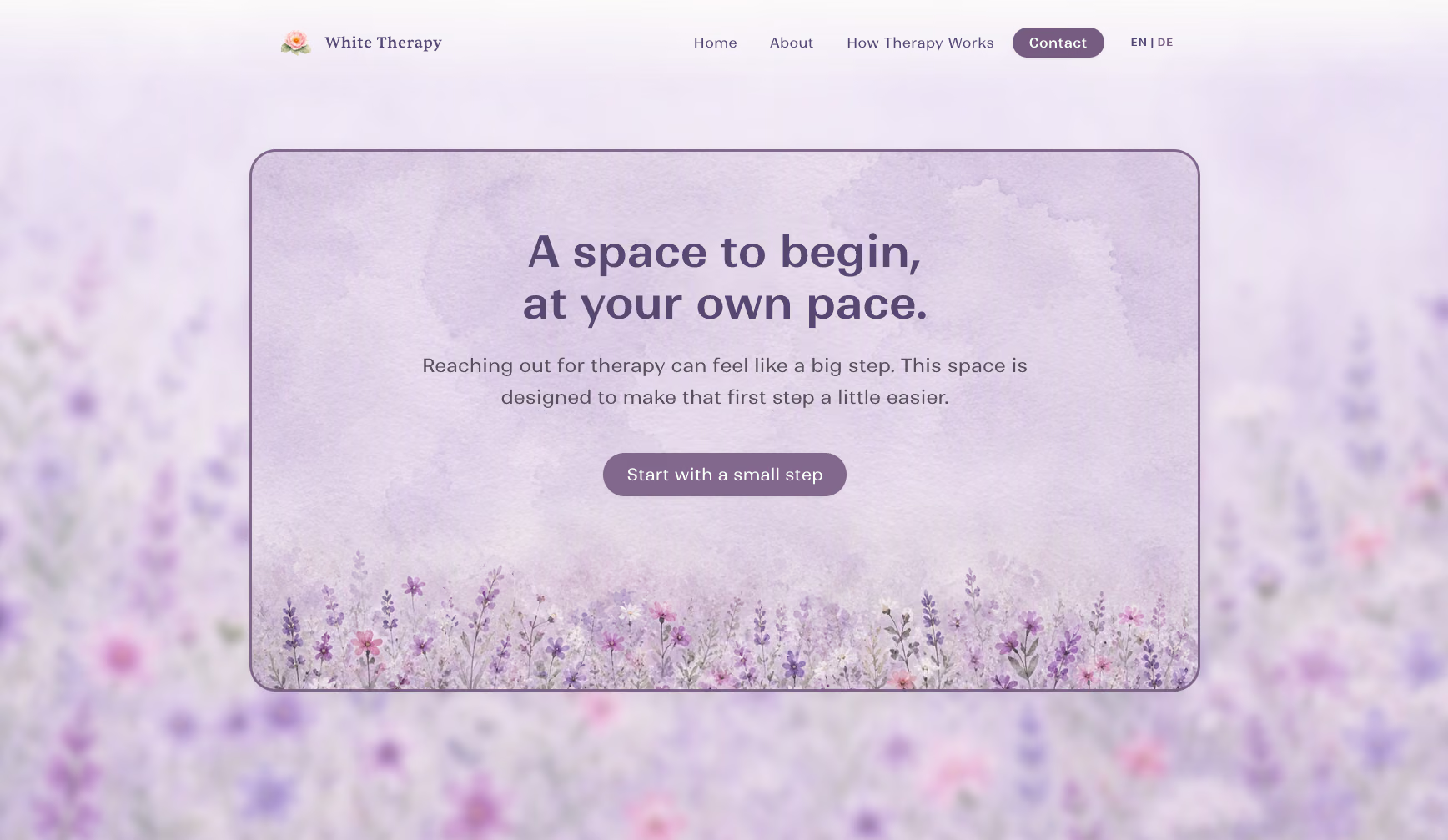
I built a therapy website to show what's possible.

I wanted to demonstrate - concretely, not theoretically - what I believe a therapy website should feel like. So I built one from scratch for a fictional practice.

Every decision was made with one question in mind: What does someone need to feel safe enough to reach out? The pacing. The language. The contact flow. The scheduling logic. All of it.

(It's also a useful answer to the question therapists sometimes don't ask out loud: "But can you actually design something that looks good?")

Screenshot of the Alvarez Therapy concept site - warm, precise, and welcoming

What working with me looks like

No vague promises. Here's what's on the table.

Available now

  • Custom-coded website - HTML, CSS, JavaScript, PHP
  • Responsive design - every screen, not just desktop
  • Blog with admin area you can actually use
  • Secure contact forms with validation and spam protection
  • Private, anonymized analytics - you see your data, no one else does
  • SEO foundations - structure, speed, metadata, done properly
  • GDPR-compliant architecture throughout
  • Managed hosting - monthly retainer:
    • Security updates and patches
    • Smaller tweaks on request
    • SEO and metrics reports
    • Improvement suggestions
    Want to manage hosting yourself? That's an option too.

On the roadmap

  • Private appointment scheduling - no Calendly, no third-party booking platforms
  • Secure client communication - no Zoom, no WhatsApp, no data leaving your infrastructure
  • Custom client dashboard - built to your practice's specific needs

These tools are in active development on my own infrastructure first. If you're interested in being an early collaborator, mention it when we talk.

Who's behind Therajava

I'm Lia. I wasn't supposed to end up here.

I have a Master's degree in Psychology. Years of experience working with clients and leading teams in institutional healthcare. A deep belief in the healing power of human connection. I was doing what I had trained for all my life.

And I was hitting walls everywhere.

The rigid structures. The administrative bloat. The way the system seemed designed to prevent the very connection it was supposed to facilitate. I watched brilliant therapists lose their fire. I watched clients fall through the cracks. I felt my own impact shrinking, squeezed by a system that cared more about throughput than healing.

So I did something terrifying. I went back to school. Again.

HTML, CSS, JavaScript, PHP, Python. Certifications - top grades, because apparently I don't know how to do things halfway. Late nights fixing bugs. Learning to see flaws in others' code and my own. A whole new world opening up. I went from full-time psychologist to full-stack developer. And honestly? It was as exciting as it was terrifying. It still is.

What surprised me was how much transferred. Programming and psychology aren't so different. Both require patience and determination - lots of it. Both demand attention to details others miss. Both are fundamentally about building structures that can hold something meaningful.

I started Therajava because I couldn't stop seeing the gap.

Therapists who were outstanding at healing but struggling to be seen. Clients who needed help but couldn't find the right person because the digital landscape was too cold, too confusing, too generic. A gap that technology could close - if it were built by someone who understood both sides.

I'm not a practicing psychologist anymore. But I'm still in service of healing. Just from a different angle. And I'm building the infrastructure that should have existed all along.

How we'd work together

Straightforward. No jargon. No disappearing acts.

  1. A free discovery call

    We talk about your practice, your clients, and what you actually need. I'll ask questions that might surprise you - because the technical decisions depend on understanding your work, not just your wishlist. No sales pressure. If we're not a good fit, I'll tell you.

  2. I build - you stay in the loop

    You'll see progress at every stage. No disappearing for weeks and reappearing with something unrecognisable. Your input shapes the work, and I explain my decisions in plain language - not developer jargon.

  3. Launch - and beyond

    When your site goes live, the relationship doesn't end. The monthly retainer covers hosting, security updates, smaller tweaks, and regular SEO and metrics reports. If you ever want to leave, the code and hosting transfer to you. No hostages.

Things people usually ask

Let's find out if we're a good fit.

I work with a small number of clients at a time - because I'd rather do a few things well than many things adequately.

The best first step is a free 30-minute call. We talk, I listen, and by the end you'll know whether this makes sense for your practice. No pitch. No pressure. Just a conversation.

Choose a time that works for you.

Book a free call

Opens an external link.